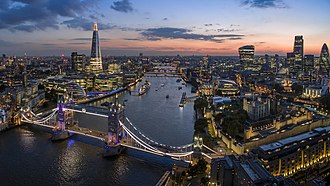
London trägt seine Vergangenheit sichtbar: enge Gassen, jahrhundertealte Bauwerke und Orte, an denen sich Epochen direkt aneinanderfügen. Als historisch geprägte Millionen-Metropole in Großbritannien zieht die Stadt Besucher aus aller Welt an. London ist eine Fundgrube für alle, die Geschichte greifbar erleben wollen — von romanischen Fassaden bis zur barocken Altstadt. Geführte Rundgänge mit lokalen Guides lohnen sich besonders — sie bringen die Anekdoten ans Licht, die in keinem Reiseführer stehen.
Für London liegt uns noch keine kuratierte Attraktions-Liste vor.
Echtzeit-Verfügbarkeit · Preise in Euro · Partner: GetYourGuide
London is the capital and largest city of England and the United Kingdom, with a population of 9.1 million people in 2024. Its wider metropolitan area is the largest in Western Europe, with a population of 15.1 million. London stands on the River Thames in southeast England, at the head of a 50-mile (80 km) tidal estuary down to the North Sea, and has been a major settlement for nearly 2,000 years. Its ancient core and financial centre, the City of London, was founded by the Romans as Londinium and has retained its medieval boundaries. The City of Westminster, to the west of the City of London, has been the site of the national government and parliament for centuries. London grew rapidly in the 19th century, becoming the world's largest city at the time. Since the 19th century the name "London" has referred to the metropolis around the City of London, historically split among the counties of Middlesex, Essex, Surrey, Kent and Hertfordshire. Since 1965 it has largely comprised the administrative area of Greater London, governed by 33 local authorities and the Greater London Authority.
Quelle: Wikipedia (en) — CC-BY-SA, ggf. gekürzt.
Hinweis: Links zu GetYourGuide sind Partner-Links — bei einer Buchung erhalten wir eine Provision, ohne Aufpreis für dich. Texte und Bilder aus Wikipedia sind unter CC-BY-SA 4.0 lizensiert.